May 26, 2009 - Every successful CWOP search now returns a link to the closest CWOP member web cam. This link is at the bottom of the returned page. If any of these links don't work, email CWOP Support, cwop-support at noaa dot gov.
May 17, 2009 - A 1.5 Mbyte PowerPoint Presentation on solar radiation measurements made by citizens including comparisons with NOAA solar radiation measurements was given last week at the Climate Monitoring Division Annual Meeting at the NOAA Earth Systems Research Laboratory in Boulder, CO.
May 05, 2009 - Karl Uppiano (CW3375) reports that his 1-Wire Weather Service for Java software now supports the new WSI603A Weather Instrument Kit from AAG.
April 25, 2009 - Visibility reports for METAR sites have been added to the NOAA mesonet map. The visibility in miles shows up below the cursor, and also in the station histories. Histories continue to take a while--maybe 20 seconds--to appear.
April 9, 2009 - From Don Eick of the NTSB: "MADIS helps us with the mesoscale applications and fill the gap in between airport observations. We also have highway and railway accidents which of course always don't match up with airports. In the Colgan Air accident near Buffalo, I am using the MADIS network data for temperature, dew point, and wind data. We have some reports of mixed precipitation in the area and the local area reports are of interest. We used MADIS also in a recent fire fighting helicopter accident in northern California located away from normal airport observations. MADIS and Mesonetworks were critical to help determine wind and temperature data, and to help determine density altitude for performance impacts." CWOP is the largest mesonet in the MADIS dataset, and Don adds "Keep up the good work!"
April 4, 2009 - Gerry Creager, AP009, has just recently brought up another CWOP server, CWOP4, and it is listed here. This new server is reached just like the other CWOP servers, by using cwop.aprs.net as the server designator in your local software.
Mar 25, 2009 - There is now a way to compare solar radiance from NOAA calibrated stations and from CWOP stations. Here's a comparison plot of a Surface Radiation Calibrated station (SRCBON) and eight CWOP stations located in Illinois and Indiana.
Mar 15, 2009 - Allen Kam of the Seattle NWS Weather Forecast Office reports that for the past 2-3 years the Seattle WFO has included a section on CWOP in ALL of their spotter training sessions. They do 6-10 training sessions each year. The spotters section of their web site has a link to a CWOP Recruiting Item under "Transmitting Data from your Weather Station to the NWS".
Mar 12, 2009 - Ron Pippin, CW5020, reports that the latest Davis Weatherlink software update, 5.8.3, appears to fix several issues.
Mar 05, 2009 - The number of entries in the CWOP database passed 15,000 today and is at 15,009 this evening. Some of these are active and some are inactive. A few people have more than one entry, but not very many. So, it is a correct statement to say that the total CWOP membership is about 15,000.
Mar 01, 2009 - Here's a zip file that shows the last packet received from each weather station during February where the first number is the number of days packets were received during the month. Stations active only one day are not listed since they are probably an error. Files like this are used to generate the stations/month graph.
Feb 09, 2009 - CWOP member Jeff Ruys, CW2323, did a neat mapping project that shows maps of current CWOP stations in any area of the world. You can click on a station icon and see the current weather data from that station.
Jan 31, 2009 - New CWOP member George Allen operates two weather stations in New England. Both stations are part of a network that monitors haze and air pollution with web cams. You can check the current images for DW2257 in the Boston area and DW2258 at Winter Harbor, Maine by going down to near the end of the CWOP Members Web Page and Web Cam List here.
Jan 18, 2009 - Davis has announced a number of firmware updates for the Vantage Pro 2 weather station that is widely used within CWOP. The updated firmware release is 1.82 and may be downloaded here.
Jan 01, 2009 - A graph of the searches per day done by the CWOP Search Tool in 2008 is shown here. The large daily increases in the first 7 months are due to 2008 APRS-IS conditions that caused traffic changes shown here and here. However, the large increase in searches during Nov 6-13 when the average number of searches per day increased to 1081, is due to Google finding the CWOP Search Tool and using it. For comparison, the CWOP Search Tool use in 2007 is shown here.
Dec 24, 2008 - Davis Weather has posted a number of firmware updates for its Vantage Pro 2 products. The current firmware release is 1.80 and may be downloaded here. This firmware fixes a number of bugs that have been problematic in the past.
Dec 20, 2008 - CWOP has members (both active and inactive) in 127 different countries. You can search through the list and find a member from any of those 127 countries by using the two letter internet code for that country preceded by a comma and space as discussed in the directions of the CWOP Search Tool.
Nov 29, 2008 - CWOP is now ranked third in the Google Directory category: science; earth sciences; meteorology; as shown here.
Nov 19, 2008 - Mathematica version 7 has just been released, and it includes support for the WeatherData[] function. This gives access to both current weather conditions worldwide as well as historical data. The list of sites covered includes all the CWOP stations. There are many interesting ways of viewing the data. The folks at Wolfram Research have also been providing hosting space for the weather.gladstonefamily.net server and the wxqc mailing list.
Sep 18, 2008 - The fundraising effort to cover findU moving, equipment and operations cost referred to in the Sep 03 item below, has been successfully completed. Thanks to all CWOP members who donated.
Sep 10, 2008 - The primary findU server is up and running at the new ISP located in PA. Within the next day or so, both the primary and the secondary findU servers will be operating normally.
Sep 03, 2008 - The primary findU server will be moving from FL to PA early next week. The server will be pulled Monday, shipped overnight, and should be up sometime Tuesday if things go as planned. All services will be moved to the secondary findU server in TX over the next few days. Some findU pages may load slower than usual, but almost everything should work. CWOP urges you to donate to cover the cost of this server relocation and operation.
Aug 17, 2008 - Due to ISP changes, the primary findU server, located in Florida, will be moved to a different location within the next six weeks. The change should be transparent to CWOP users because the secondary findU server, located in Texas, can carry the entire data stream. Last month, the findU servers provided 12,455,837 wxpage responses. Weather pages were second only to the find command which provided 16,243,193 pages.
Aug 07, 2008 - The daily number of weather stations on APRS-IS is shown over the past 3 years here. The drop to the far right is July 19 when the core servers started accepting only verified packets. The drop just before that is Apr 10-12 when the Tier 2 servers started accepting only verified packets.
July 21, 2008 - Changing the APRS core servers to only accept verified packets has resulted in many weather station operators not being able to get their data to CWOP. You can track the number of CW/DW stations (last heard on 20080719) not getting data to CWOP here. This started at 1215 stations and has decreased as more people change to the "cwop.aprs.net" servers as recommended here.
July 19, 2008 - The process to change APRS core servers to only accept verified packets has started. CWOP members using the FreeWX software package should check here for suggestions on changing servers.
July 17, 2008 - In the next few days, the APRS Core servers will stop accepting unverified packets. Any CWxxxx, DWxxxx or unverified ham packets will be rejected and not reach findU or CWOP or MADIS. To prevent this from happening to their packets, CWOP members need to check the recommended servers and make changes if needed.
June 20, 2008 - Here is a second newspaper article giving even more info on Philip Gladstone and the NOAA Environmental Hero Award.
June 16, 2008 - Here is a newspaper article about CWOP's own, Philip Gladstone, and his recent NOAA Environmental Hero Award.
June 15, 2008 - Here is a diagnostic aid that may help determine if a problem (that has existed more than a few days) is with your local computer or with the APRS-IS network. If data from your registered CWOP weather station are not on findU, check here to see the last date that a packet from your station was seen on APRS-IS. Then check here to see how many other stations share that date. If only a few, then the problem is probably with your computer or software. However, if more than a few, there may have been a change in the APRS-IS on that day.
May 19, 2008 - Andy Nash, CW8637 and Meteorologist In Charge (MIC) at the NWS Burlington, VT Weather Forecast Office, has written an item about weather data from private citizens and how these data are used. You can see it on page 16 here.
May 04, 2008 - There was a short article in The New York Times today about Bradley Feldman's CWOP weather station taking the temperature of Brownstone Brooklyn. You can read and enjoy it here.
Apr 18, 2008 - This graph shows number of weather stations using different APRS servers on a daily basis since the start of the year. NH means non-ham; HM means ham; CR means CORE servers; CW means CWOP servers; and OT means other servers including Tier 2 servers.
Apr 14, 2008 - Regarding server changes, Roger Dickey (CW9396) reports "I am using open2300 software. While it has a configuration file, the first two server names are hard coded. Open2300 users will have to find the server names in the file rw2300.c, change them to cwop and recompile. I had changed my configuration file and it ‘worked’. In fact, aprswest was the hard coded default."
Apr 12, 2008 - Some APRS servers, which previously accepted citizen weather packets, no longer pass certain weather packets to the findU server (which sends the data to MADIS which sends them on to over 450 user agencies). If your weather data are no longer getting to findU or to MADIS, then you need to check about which servers you should use.
Mar 25, 2008 - There will be no weekly update to the CWOP database due to an injury to the updater (broken small bone above ankle). Hopefully things will return to near normal next week.
Mar 17, 2008 - Dave Helms (CW0350, CW0351) has developed a CWOP Archive Search using on-line Google search technology. This allows you to enter an item and find if it has been discussed on the CWOP Data Quality Discussion List. For example, enter "barometer calibration" and you'll see postings that discussed how to calibrate your barometer.
Mar 08, 2008 - With great pride, we announce that Philip Gladstone (CW0003) has been selected to receive a NOAA Environmental Hero Award on Earth Day, 2008. He was nominated by the National Weather Service, NOAA Oceanic & Atmospheric Research and the NOAA Office of Education for his volunteer effort in developing and maintaining a highly-praised web site that provides information to weather station operators. This gives citizen operators the necessary tools to improve the quality of the data they contribute to NOAA research and operations, which in turn results in better weather services for the general public. Philip is one of the key builders of CWOP and is highly deserving of this prestigious award.
Feb 26, 2008 - For those running Davis Weatherlink Software on a Windows system, Davis has issued an upgrade to the software to bring it up to V5.8.0. The new version of the software prevents crashes if the data is being accessed over a network and allows multiple connection ports. For those running Weatherlink software on a Macintosh System, they have issued upgrade V5.0.3c which resolves a problem with crashing when running Leopard systems. They also have released firmware updates for the Vantage Pro consoles in the form of Version 1.73. This fixed a bug that gave the High Rain Rate an incorrect time stamp and a bug that caused an inaccurate barometric reading at high elevation.
Feb 24, 2008 - We have started issuing CWOP IDs that start with DW followed by 4 numbers. We have run through 10,000 IDs that start with CW, so we have changed to DW and you can see the list of DW stations that have sent packets.
Feb 21, 2008 - There was a fire (or at least, smoke) near the cwop.aprs.net server at Texas A&M last night. Gerry Creager reports, "The Fire Dept has left but the smoke's still here". The effects on CWOP traffic can be seen as zeros in station count and in packet count for CWOP-1, CWOP-2, CWOP-3 from 01 to 03 UTC for 20080221.
Feb 07, 2008 - The author of the software package used by all the APRS-IS servers has asked that all CWOP members use a server designation of "cwop.aprs.net" and port 14580. This changes earlier recommendations made here. Specifically, members are asked to no longer use "rotate.aprs.net" and to not use individual server names. The packet rate recommendation under item # 1 of the CWOP FAQ remains unchanged. Any changes to CWOP recommendations will be posted here.
Jan 28, 2008 - This appeared in the NWS Weather Forecast Office Seattle Winter 2007 Sky-Warn Spotter News: "Citizen Weather Observing Program (CWOP) - CWOP is a system that permits those with automated weather stations to report their data on-line to a suite of weather observation web sites. A growing number of Skywarn weather spotters are taking advantage of this opportunity. If you have an automated weather station linked to your personal computer combined with broadband or DSL communications, or you get such a system as a gift, please visit www.wxqa.com for more information if you are interested. You could join the CWOP team!"
Jan 21, 2008 - Yesterday, there was a slashdot posting about Personal Weather Stations that mentioned CWOP. Because of this, the CWOP web site traffic for yesterday was about eight times normal.
Jan 16, 2008 - There is a new recommendation on the maximum data packet rate that CWOP members should use to send their data. This is discussed under item # 1 of the CWOP FAQ linked from the upper right. Note that if you are sending packets more often than one every 10 minutes, you should reduce your packet rate to that and you should select the minute you transmit as pointed out in item # 1 of the CWOP FAQ.
Jan 07, 2008 - Steve Dimse reports that in 2007, the findU server received 422,262,687 weather reports and this is a 29.5% increase over 2006. Since 2000, about 1.24 billion weather reports have been received by findU.
Jan 04, 2008 - Jason Karvelot of Davis Instruments will give a CWOP-related presentation concerning Atmospheric Observations for Weather and Climate at the AMS Annual Meeting in New Orleans later this month.
Jan 01, 2008 - The CWOP Search Tool has been used for the past year as shown by the searches per day over 2007. Item #8 in the CWOP FAQ tells how to use the search tool to check your data through most of the paths they take through CWOP.
Dec 26, 2007 - This is a CWOP-related item from the Hanford, CA NWS Weather Forecast Office.
Dec 20, 2007 - Here is a news article by Donna Healy of the Billings Gazette from last spring that mentions CWOP.
Dec 07, 2007 - We're happy to report that Weather Underground has started posting APRSWXNET/CWOP weather data on their extensive web site. This WU blog posting gives some information. They obtain the data from MADIS and derive an ID for each of the APRSWXNET/CWOP stations by adding "M" in front of the 5 character NWS ID.
Nov 22, 2007 - This shows daily citizen weather station traffic on APRS-IS during 15 May 2005 to 22 Nov 2007. Also shown is an expanded scale view covering 2007 only. The changeover to the APRS Core servers that started January 6 of this year (see four January 2007 news items below) is shown here.
Nov 10, 2007 - Here's a report titled "Post-hurricane Analysis of Citrus Canker Spread and Progress towards the Development of a Predictive Model to Estimate Disease Spread Due to Catastrophic Weather Events". The analysis used CWOP weather observations.
Nov 02, 2007 - Brian Hamilton reports that his Weather-Display program, which was the first program that supported CWOP, can now be used on an Intel MAC.
Oct 24, 2007 - Steve Dimse is installing a new and more capable server at findU. Read more about it and how to test it for Steve here.
Oct 14, 2007 - Here is a weather station with no computer that sends data directly to the internet. In addition to using an Ethernet connection to the internet, it can also use a wireless connection to a Wi-Fi access point to send data to CWOP on the internet.
Oct 02, 2007 - If you are having trouble sending your packets to an aprs server (as some currently are), try changing the aprs server designation in your local software to "rotate.aprs.net", and use port 14580. This is the most reliable way to send your weather data to CWOP.
Sep 19, 2007 - Google Directory ranks web pages in various categories and sub-categories. The Google Science - Earth Sciences - Meteorology sub-category ranks 1,073 web sites and the CWOP web site is the fifth one according to the Google PageRank order.
Aug 27, 2007 - We have just learned of this somewhat dated item recently. It has an interesting perspective on CWOP in the second paragraph.
Aug 21, 2007 - Davis Instruments has released firmware version 1.7 for their Vantage Pro 2 line of weather stations and that new firmware can be downloaded here.
Aug 13, 2007 - The U.S. Department of Homeland Security, Science and Technology Directorate, lists CWOP and MADIS as national assets for the "BioWatch" network in Meteorological Integration for the Biological Warning and Incident Characterization (BWIC) System: General Guidance for BWIC Cities dated February 2007.
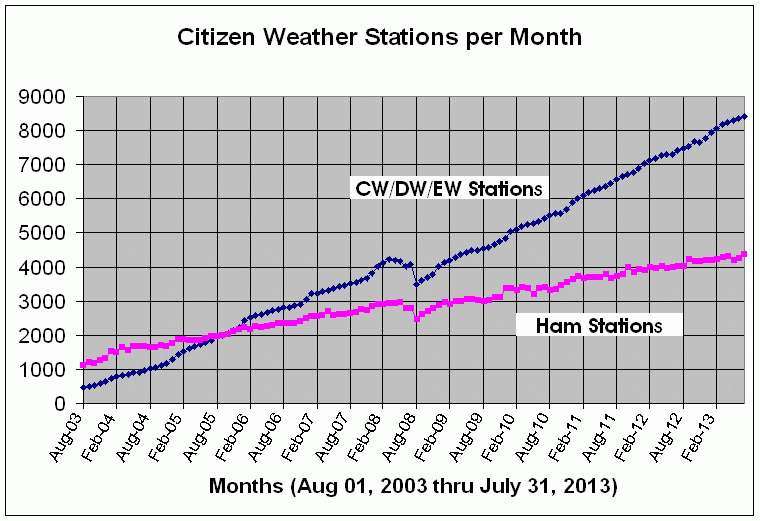
Aug 05, 2007 - This graph shows CW and Ham weather station traffic on APRS-IS over the past four years. Note the increases that always seem to happen just after people have opened certain Christmas presents.
July 15, 2007 - The following message is from Steve Dimse, K4HG, "Ten years ago today I registered aprs.net. For a week or two before that I had been testing APRServe, with consolidated data from San Francisco, Atlanta, and Miami, but the switch over to aprs.net marks the official birthday of the APRS Internet System. What a decade it has been! Thanks to all the (far too many to name) hams whose contributions have grown the system to what it is today." Also, lots of non-hams have made contributions to CWOP (APRSWXNET) during this time and thanks also goes to them.
July 01, 2007 - The RSS feed associated with this CWOP News page is operational again thanks to Philip Gladstone. Previously, an internet service was being used, but that service has apparently vanished for good. So, Philip has developed his own RSS service and that is how you can find changes on this page. If you were already signed up, you may have to sign up again.
June 28, 2007 - Some newer members may not be aware that CWOP has an on-line store. CafePress distributes several summer-time items like hats and T-shirts with the CWOP logo displayed in full color. CWOP gets no money from these sales as all items are offered at the minimum CafePress price.
June 11, 2007 - The CWOP Search Tool now shows the last packet from the searched for station for each of the last ten days. It also shows number of packets from that station in the last hour of each day and total number of packets from that station in each of the last ten days.
June 06, 2007 - As of last week, the MADIS surface data set is being used in a high resolution (1.5 km) local area model to provide plume dispersion information to the Department of Homeland Security (DHS) with the Geo-Targeted Alerting System (GTAS) using the FXC workstation. In the event of a toxic release in the Washington D.C. area, plume maps (an example is shown in the FXC link) will allow forecasters to quickly identify the propagation of a toxic cloud and alert DHS officials in real-time. DHS emergency preparedness officials will then be able to determine public warning areas for reverse-911 call-outs. Depending on the results of a one year test, this public warning capability is planned for expansion to all major metropolitan areas in the country. CWOP is the largest MADIS mesonet comprising over 20% of MADIS stations.
June 04, 2007 - MesoWest has a new feature called MyMesoWest where you can construct your own way to view the weather data in your (or any) local area. Here's a MyMesoWest profile for the Boulder, CO area.
May 08, 2007 - There is now the capability to list new stations by NWS County Warning Area (CWA). In addition, you can subscribe to an RSS feed of new CWOP stations for a given CWA. Use this CWA map and click on your CWA to see the list and to subscribe to the RSS feed.
Apr 16, 2007 - The week of April 15-21, 2007, has been designated as National Volunteer Week following Executive Order 13041, “Responsibilities of Federal Departments and Agencies with Respect to Volunteer Community Service.” This Executive Order is intended to ensure that the Federal Government supports and encourages volunteer community service. CWOP is thousands of volunteer members contributing weather data useful at the community level and useful to NOAA at the national level. During National Volunteer Week, CWOP volunteers will contribute about 2.5 million local weather observations as a public service.
Apr 11, 2007 - Philip Gladstone has updated his RSS new sites page to incorporate a new feature from Google. Check it out here. Adding "?site=C0351&within=100" (without the quotes) to the end of the URL will restrict the area. In this case, to within 100 miles of CW0351.
Mar 07, 2007 - A 4Mb video of the NOAA Mesonet Map gust data from a recent upper midwest low pressure system covers a 48 hour period with each frame covering two hours.
Feb 25, 2007 - The Arctic Climate Monitoring Program (ACMP) is a K-12 program sponsored by the National Science Foundation, National Weather Service Alaska Region, and the University of Alaska. CWOP provides this educational program a good way to collect data at numerous student operated weather station sites in Alaska.
Feb 1, 2007 - There is now a way to view CWOP snow data. To view your snow data, just replace the 5 character NWS ID (C5634) with your 5 character NWS ID in the URL. There will be some type of map access soon along with this help page.
Jan 27, 2007 - Three weeks after the change in APRS-IS servers nearly half of the CW stations have changed over to using Core servers. We recommend that all CWOP members sending data via the internet should enter "rotate.aprs.net" with port 14580 as their designated server. More info under items 1 & 2.
Jan 20, 2007 - Two weeks after the change in APRS-IS servers, data flow has been irregular. This was caused by some CWOP members continuing to use the old, unreliable servers that are no longer recommended. The Core servers have been 100% reliable during this time and no data packets sent to the recommended Core servers were lost. Everyone should change their server list following these procedures.
Jan 13, 2007 - One week after the change in recommended APRS-IS servers, CWOP data flow is near normal. Members are gradually changing over to the new recommendations using information under items # 1 & 2. Most of the program authors have changed the default servers in their programs so that if you upgrade your software, you will also update your server list. One way to see if you are using a recommended server is to look at the raw packet list linked from the left side of most findU pages and see if one or more of FIRST, CORE-2, APRSFL, or FIFTH appear in the most recent packets at the bottom of the raw packet list.
Jan 6, 2007 - The Tier 2 APRS-IS server operators have decided to discontinue their support of CWOP. If you have not already done it, you should change servers to one of the Core servers as discussed here. It is best to use port 14580 at this time.
Dec 30, 2006 - Here's a listing of weather station sites that have nearby pictures available. These pictures may or may not be of the weather station or of the site, but they are interesting! Click on "Find nearby photographs in Flickr".
Dec 26, 2006 - A Search Tool for the CWOP database is now available. Click on "Member Lists" above to access it.
Dec 17, 2006 - This National Park Service Report shows that CWOP Data are in the National Park Service Climate Inventory. CWOP stations contribute the largest number of real-time stations near these National Park Service boundaries of all available networks.
Nov 13, 2006 - Jason Karvelot of Davis Instruments Corp. has prepared a presentation and paper for the 87th American Meteorological Society (AMS) Annual Meeting in San Antonio, TX in January 2007. The paper is titled New Cooperative Observer Networks and Instrumentation Data Quality and presents results on data quality of weather stations like those used in CWOP.
Oct 25, 2006 - Here's a listing of the APRS-IS server traffic for the APRS-IS servers. This shows internet only traffic and does not include any station that sent data via radio. This is the first place to check if you are having a problem connecting to one of the servers. If that server is showing reduced traffic or none at all, try one of the ones that is showing fairly steady traffic.
Oct 6, 2006 - There are different ways to use dense, high quality, mesonet observations, and the IPPC Decision Tool shows yet another one. Oregon State University's IPPC has developed an on-line decision aid using mesonet observations to initialize phenology models and a degree-day calculator in support of agricultural and pest management decision making. The mesonet observations, including CWOP, used in the database are linked with 44 degree-day models for prediction of insect propagation, plant diseases, weeds, crops, and mating disruption pheromones. An explanation is given on this poster.
Oct 2, 2006 - Here's a Master's Thesis titled "A Study of the Viability of a Mesoscale Network using Rooftop Weather Systems" by Ashlee Caroline Hicks. Ashlee used CWOP data in her research at Florida State University.
Sep 28, 2006 - Here's a news item about home weather stations in the Spokane, WA area.
Sep 15, 2006 - A video of the MADIS wind data for Hurricane Ernesto landfall on the North Carolina coast is available and covers a 36 hour period with each frame showing two hours.
Sep 04, 2006 - FindU now has support for tide stations; "call=k4hg" or "lat=24.6&lon=-81.5" in the URL after the question mark provide other location criteria. Comparisons with measured tide levels using a battery-powered water level measurement device designed for APRS are available. More tide level data are available from another one of these units located on the end of a pier.
Aug 17, 2006 - Here are three items urging people to join CWOP. These are from NWS Forecast Office newsletters/documents: (1) Jackson, KY, Tech Tips on page 5; (2) Seattle, WA, Skywarn Spotter Notes, lower quarter of page; (3) Hanford, CA, Emergency Preparedness Committee.
Aug 5, 2006 - The Royal Meteorological Society educational weather project, MetLinkInternational, is an internet-based activity where participants make and exchange weather observations by means of an online database. Using these data along with weather charts, satellite images and web cams, meteorological professionals show how to analyse and interpret the observations. Malcolm Walker, the Education Resources Manager of the Royal Met Society, welcomes any questions and invites interested CWOP members to participate in the two upcoming observation periods, Sept. 25 to 29, 2006 and Jan. 29 to Feb. 09, 2007.
July 22, 2006 - MesoWest has developed a very neat mapping application based on Google maps. It can be accessed here and comes up for RAWS stations in Colorado. To see CWOP and other stations, use the settings box in the upper right to select "All Networks" and press "Map It!". To select other areas in North America use the adjacent box. Lots of other features too!
May 25, 2006 - The Davis website now has the released version of Weatherlink 5.7 available for download. Note that the APRS string is in the Log file for diagnostic purposes. For Vantage Pro and Vantage Pro2 systems, the raw barometer reading, R reduction value and Altimeter Setting is in the Log file adjacent to the APRS string to help ensure correct data. Due to unexpected staff changes, there was no Beta version testing. Davis asks people in the field to use the latest software and let them know if it appears that correct data is being reported. Please note that for Weather Monitor II users, it's up to you to set your systems manually to the altimeter setting value.
May 19, 2006 - This summer, the University of Alaska is sponsoring weather stations in the Bering Strait School District around Nome. Also the Fairbanks NWS Weather Forecast Office is sponsoring weather stations at Alaska DOT sites around Fairbanks. The station IDs ending in "A2" in this list of Alaskan CWOP stations will comprise this combined network shown in the map of Alaska CWOP stations.
Apr 22, 2006 - CWOP will be represented at the Maker Faire in San Mateo, CA this weekend. A 5.25 MB Power Point on what CWOP is and does will be presented in the Citizen Science session on Saturday afternoon.
Apr 9, 2006 - Dave Klimas, N7DRK, has designed a way to send weather data to CWOP over the internet without using a computer. He modified a very small serial to ethernet adapter to send the data stream from his weather station to the aprs servers on the internet without a computer. Details of what he did and a picture of the very small unit are here.
Mar 23, 2006 - Philip Gladstone, CW0003, has added a CWOP equipment types in use page to his CWOP Quality Checking pages. It shows how many of each of the many hardware/software combinations are in use within the CWOP network.
Mar 18, 2006 - Three new programs that support CWOP have been added to the CWOP info page in the table a few screens down. This brings the total to 22 different software packages that support CWOP.
Mar 5, 2006 - A Google search feature is now located at the bottom of the Main Page of this web site. It's interesting to search the site for different IDs and see how often they appear.
Mar 3, 2006 - Karl Uppiano, CW3375, has written a 1-Wire Weather Service for Java. A complete description is given here.
Feb 9, 2006 - At 9 PM, WALA Fox 10 News in Mobile, Alabama used CWOP data on the air for the first time. Doug Peters, Fox 10 News Meteorologist, reports that they plan on using local CWOP temperatures on some or all of their newscasts and in the event of a storm, they also can plot wind speeds from CWOP stations.
Jan 10, 2006 - WeatherUnderground, the Internet's first weather information portal, has added Citizen Weather Observer Program links to its Additional Resources page, including the CWOP Weather Station Resources page, Weather Station Guide, and Philip Gladstone's QC Listserver. Both CWOP and WeatherUnderground hope to support the Personal Weather Station hobbyist with these combined resources.
Dec 22, 2005 - We now have the capability to incorporate pictures of your weather station into the CWOP Station Info Page. Instructions on how to upload your digital images are here.
Dec 12, 2005 - Here's a graph of the number of weather stations, by type (CW position, Ham Position, Ham Positionless, Ham hexidecimal) since May 11, 2005. Note that the number of CW stations is growing at an annual rate of over 50%.
Dec 4, 2005 - A significant problem exists when a CWOP station gets stuck and sends repeating data that do not change. This can happen when communications are lost between the sensor(s), the weather station hardware, or the PC data logging application. Another cause of repeating relative humidity data is when the application sends humidity of 100 %, i.e. h00, when there is no humidity sensor present. Philip Gladstone has added a page that lists stations with repeating or stuck data to his suite of quality checking tools accessable through the Data Quality link above or through the Shortform link. If your station is on the WxStuck list or if you see that your data on findU is not changing, try these procedures: 1) restart the PC and data logging application; 2) Make sure the connection between the PC and weather console is OK; 3) Check to see that the weather console has power; 4) Check the connections between the weather console and the sensors. If you have a wireless system, check to see that the sensors have power, including a fresh batteries and distance between the sensor and the weather console supports solid communications. For Ham Radio stations, check to see that the connection between the weather console and the TNC is functional. If you have doubts about why your station appears on the "WxStuck" web page, please contact russ@cwop.net or dave@cwop.info.
Nov 22, 2005 - A 23 minute training video, prepared by Colorado State University, on the best way to take high-quality snow measurements is now available for download here.
Nov 20, 2005 - CWOP was invited to present results at a Royal Meteorological Society meeting in London. The RMetS presentation was prepared by Dave Helms (CW0351) and given by Royal Met Society member Tim West (CW0521) yesterday. A summary of the meeting is here (page 5).
Nov 19, 2005 - Here are three examples of CWOP Quality Checking graphical results being embedded into CWOP member web pages: Westminister, MA; Carter Lake, IA; and Jacksonville, FL.
Nov 10, 2005 - The details of a hazardous gas release near Boulder, CO are contained in this TV news report where the on-site reporter mentions "very light winds out of the south". Surface mesonet winds were available and note that the winds near the site agree with the on-site report of very light from the south while the nearest metar winds are 7 mph out of the north. Diffusion models using only the metar winds would have the hazardous plume spreading in the wrong direction and would have given the all clear signal too soon.
Nov 9, 2005 - CWOP data are being used, along with other data sets, by the Penn State Climatologist.
Nov 4, 2005 - The replacement router is up and working at the Yuma, AZ aprs server and the CWOP traffic is back to normal. Thanks to Dick for his diligent efforts getting the problem reported two days ago fixed.
Nov 2, 2005 - Received from Dick Stanich, KB7ZVA, the operator of the first server in the list under item # 2 here, "I lost my dsl router (up in smoke) this evening and it may not be until late friday before I get things up and running. My provider has to send it, as none are available in Yuma, Arizona. I'm banging this out on a very basic dial-up...Sorry!" Dick adds..."Remember 'stressed' spelled backwards is desserts. There is good in everything ;)"
Oct 23, 2005 - At long last, we are ready to sign-up volunteers to make snow measurements. We welcome volunteers from around the world and you can access sign-up information with links to sources of information on how to take accurate snow measurements. This is for sign-up only as the data entry software is not fully ready yet. Write your snow measurements down so you can enter them later.
Sept 29, 2005 - Regarding the Davis Weatherlink 5.6 software reporting wind gusts to CWOP/APRS. In order for Weatherlink to "code up" the wind gusts, the monitor or bulletin window must be opened and running in the background. If the program is just opened and not running either of these windows, just the average wind will be reported. This important point is not clear in the instructions.
Sept 27, 2005 - The findU primary server (www1.findu.com) has been installed in the new location and has been stable since 00 UTC Sept 24. Feel free to use it as much as you wish. The revised IP address is 66.37.46.6 and all of the URL's that were available before the move have been restored and work fine. During the move, the data to NOAA were passed through this backup URL.
Sept 21, 2005 - FindU's primary server is being pulled tonight for shipping to its new location. We will likely be on the backup server for the next 2 days. This will mean very poor access, as the backup server cannot even handle half the load. Continue to send your weather data to the aprs servers, but please limit your use of findU otherwise.
Sept 18, 2005 - Here's a neat way to look at the worldwide extent of CWOP. I used right click to zoom in and out.
Sept 16, 2005 - Rex Pirkle, K8CYJ, has added a twist (cyclonic) to the CWOP logo. Whether or not you see it may depend of the settings for your firewall. I see it with IE at work (no local firewall), but not with IE or Firefox at home where I do have a local firewall.
Sept 1, 2005 - Circumstances have dictated that the findU server be moved. A new location in Pittsburg has been secured and the server will be moving in the near future. There may be some outages and/or slow response as the older backup server tries to carry the full traffic load. During this time, new CW numbers can be obtained by sending an e-mail to the address at the bottom of this page.
Sept 1, 2005 - The Davis website now has the final release version of Weatherlink 5.6 available for download. A CWOP member reports that it works just fine. This version produces wind gust data. Be sure to configure to use the "NOAA" standard.
Aug 30, 2005 - As the warm days of summer draw to an end, we are working on a really cool capability. Hopefully, we will be able to acquire snow measurements taken by CWOP members and sent in via the web. An announcement that we are accepting volunteers for this snow data collection service will be made here sometime in September.
Aug 22, 2005 - In the July/August issue of Weatherwise, there is an article titled, "Helping Hands", by Joe Schmidt, CW0002. It describes how ham volunteers at the NOAA National Hurricane Center use the MADIS web site to gather data. It also mentions the record setting reports from CWOP stations CW0262 and K4ZZR during Hurricane Jeanne last year.
Aug 21, 2005 - Here is an item on CWOP from the Marquette, Michigan NWS Weather Forecast Office web site.
Aug 18, 2005 - Since January 1, 2005, there have been about 40 new persons entered into the CWOP database each week and during this same time, the number of stations sending data to CWOP and on to MADIS has been growing about 18 stations per week.
Aug 4, 2005 - When a web site appears on Slashdot, the resulting traffic is often so high the site becomes unavailable, a situation known as Slashdotting. Steve, K4HG, the developer of the server that all CWOP data goes through, wrote this Slashdot item on a new amateur radio satellite and here is his after action report of what happened and why CWOP data went down for awhile, but not for very long. While not weather-related, the downlinked data from this amateur satellite on the ISS is available.
July 20, 2005 - There is an item on CWOP on page 8 in the NWS Elko, Nevada Weather Forecast Office Spotter Newsletter.
July 15, 2005 - Mark Teel (CW4097) has added CWOP client support to his open source software wview which runs on Linux/BSD/unix/Darwin platforms and is developed to provide 24x7x365 reliability.The wview User Manual contains installation and configuration details.
July 3, 2005 - Google maps are now available on findu.com, also reachable by "Maps/Data displays" above right. Also, here shows several Expedia maps and the Google map below those. Replace the "kb0tvj" in the link with your callsign or CW number (CWxxxx). Center Google map by double clicking and use arrows to do fast panning. You can switch the view to see a satellite image of approximately the same area.
June 8, 2005 - An icon relating to CWOP has been added so that if you make a page on this web site a favorite, the Microsoft icon normally used will be replaced with a very small version of the CWOP logo.
June 1, 2005 - The number of CWOP stations reporting data to MADIS in a one hour period exceeded 2400 stations for the first time today. At one time there were 2404 stations reporting. CWOP is NOAA's largest real-time observing system thanks to our many data-contributing members.
May 28, 2005 - The WUHU add-on application, #15 in the table here, now supports the "base" versions of the Ambient VWS and WeatherView32 programs in addition to supporting LaCrosse hardware.
May 24, 2005 - A new feature has been added to the findu server. It is RSS which stands for Really Simple Syndication.
May 13, 2005 - Dave Heider (CW3501) has added CWOP support to his WeatherView32 program. There are upgrade instructions and other information for users of version 6 WeatherView32.
May 11, 2005 - Brad McConahay (N8QQ) has developed an APRS Variable Replacement Script to add APRS data to a web page.
May 10, 2005 - Mathias Kemper (CW3755) has developed a CWOP information page in German.
May 1, 2005 - Stan Horzepa (WA1LOU) has published a review of the Weather-Display program in the May issue of QST. This one page review is on page 54 of the journal, and is not available on-line.
April 8, 2005 - The traffic through MADIS from CWOP stations worldwide exceeded 2300 stations for the first time today.
March 17, 2005 - Today, St. Patrick's Day, we had the luck of the Irish and the number of CWOP stations reporting went above 2200 for the first time. At one point the CWOP traffic count was 2206 stations. There are currently 4899 member locations in the CWOP database.
March 10, 2005 - Some CWOP members have put together the Weather Station Siting, Performance, and Data Quality Guide. This is a beta release and we are asking for CWOP membership comment and feedback on ways that this 85 page document (2.2 Mbyte PDF) can be improved. We hope it will become a vehicle to further CWOP data improvement.
March 7, 2005 - The PC-Wetterstation/WSWin program now supports CWOP. This uses the VWSAPRS add-on to send the data from PC-Wetterstation to CWOP. More information is at CWOP info, in the table a few screens down where PC-Wetterstation is item # 8 in the alphabetical listing of programs supporting CWOP.
March 3, 2005 - A station's altitude and location are important to the data quality checking process and if these numbers are wrong, the quality checking will not work well. Here's the CWOP Altitude/Location Error Page that provides a way for members to check for possible problems with the altitude and location information used in the quality checking process. Also a log-log plot of registered station elevation vs. USGS elevation. The linear clustering a factor of about 3 below the diagonal is from stations where the operator entered elevation in feet rather than meters.
March 1, 2005 - The NWS Jacksonville Weather Forecast Office has a notice advertising CWOP on the JAX web page. It's about halfway down on the right side.
February 19, 2005 - Vanprod version 2.0.1 now has Linux, Unix, and Mac OS X support for CWOP. More information is at CWOP info, in the table a few screens down. Vanprod (written in perl) is item # 12 in the alphabetical listing of programs supporting CWOP.
February 11, 2005 - Many of the CWOP pressure measurements are not properly calibrated and show excessive error. This CWOP miscalibration report lists stations that could very easily improve the quality of their barometric pressure with a single adjustment.
February 2, 2005 - Feedback was reported from forecasters in the Huntsville, AL Weather Forecast Office (HUN) that they found the CWOP data of great use during the ice event this past weekend. They regularly consulted and used CWOP data with other data to issue statements.
December 30, 2004 - CWOP is mentioned in an article and sidebar in the NY Times Technology Section. The article, "Hobbists Fill Out the Weather Map" is about personal weather station data used by the meteorological community. The sidebar, "Knowing More than Which Way the Wind Blows" is about different weather stations and software packages that are available. Both give the cwop.net link that is now active as is cwop.info.
December 2004 - Davis has recently released version 5.5 of their Weatherlink software. This release fixes a problem with barometer calibration which should improve data quality. Complete details on how to set-up this version are here.
November 2004 - Changes: 1)There have been a number of recent changes to the findu.com server including a new weather display page; 2)The Weather-Display software, version 10.19t, now has capability to automatically change to a different server when there is a server problem.
October 2004 - For some time, CWOP has kept a list of member web pages where links to the many member web pages are listed. Now, in addition to web pages, we also list links to member web cams. If you'd like to have links to your web page or web cam listed, let us know.
September 2004 - When Hurricane Jeanne made landfall, the NOAA Observing System between Melbourne and Miami in eastern Florida was disrupted. However, two CWOP stations continued to report measurements after other weather stations had gone silent. Both Emilio Sanseviero and David Lane had equipped their stations with back-up power. Emilio's DSL service went down when the eyewall was overhead, but David's remained up during the eyewall passage. Both stations were undamaged by Jeanne (and Frances earlier) and were sending data as soon as DSL service was restored. More details are here.
September 2004 - CWOP meta-data are now part of the NOSA database. Open the "OAR" folder and then click the square next to "FSL-CWOP". There are many ways to view the contents of the NOAA Observing System Architecture (NOSA) database with this viewer.
September 2004 - On September 10, a presentation titled "Citizen Weather Observer Program (CWOP) for Collection and Use of Citizen Weather Data" was given at the NWS Great Divide Weather Workshop (GDWW) sponsored by the Billings, MT Weather Forecast Office. The GDWW2004 presentation is about 2 MB and can be downloaded here.
August 2004 - Hurricane Charley came ashore and passed over central Florida on August 14. Here are some radar and data images for CWOP stations taken by Dave Helms (CW0351) during the hurricane passage. More info on Hurricane Charley
April 2004 - The National Weather Service in Huntsville, Alabama and its parent agency, the National Oceanic and Atmospheric Administration (NOAA), have recognized two local recipients for this year's NOAA Environmental Hero Award. The 2004 recipients include two CWOP members, Anthony Guillory (K4ARG) and Paul Meyer (KF4TTB), recognized for their extraordinary level of personal time and support toward development of a Northern Alabama observing network. Through their contacts with the amateur radio community, Anthony and Paul have deployed 8 surface weather stations and registered them with CWOP. Most of these sites are operated by private amateur radio operators, and Anthony and Paul have strengthened the bond between the "ham" community and the National Weather Service across the Tennessee Valley. "The addition of these weather stations has enhanced the surface observing capabilities of the NWS in northern Alabama and adjacent states. Benefits include more precise analyses of weather elements associated with severe thunderstorm initiation and excessive rainfall, as well as improved validation of high resolution gridded forecast products" according to Tom Bradshaw, SOO, Huntsville WFO.
April 2004 - The Picnic Rock Wildfire in Northern Colorado had burned 8,700 acres and one house by April 3. It had also forced the evacuation of 139 homes. The closest reporting weather station, 10 miles south of the fire, was CWOP station WA0BAG-5 at 7142 feet on Bagg Mountain. Reporting weather data within 20 miles of the fire, there were five CWOP stations, one Colorado DOT station, one NWS/FAA station, and one USFS RAWS station.
April 2004 - A capability to sent MADIS Quality Checking and Monitoring System reports to CWOP station operators by e-mail is now available. Details under item # 3 on Data Quality page (link on left side above).
March 2004 - There is a new capability on findu.com that allows recall and display of historical CWOP weather data since April, 2000. To access this capability, enter this historical data URL and make the appropriate changes to the date and call parameters. The parameter "last" is the total time window that will be recalled and is limited to 48 hours or less.
March 2004 - On March 6, there was a tragic water taxi accident in Baltimore Harbor that caused five deaths. Initial investigation reports indicate that the accident was due to an unexpected high wind gust. CWOP station, CW1550, operated by Gus Campbell at his home in Halethorpe, MD about 5 miles west of the accident site, measured this isolated 53 mph gust between 2045 and 2100 UTC. This may be the wind gust that caused the accident at about 2100 or 4:00 PM. Gus reports that "About 3:51PM on Saturday 3/6, a squall blew through on the leading edge of a front. The sun was shining brightly the whole time. There was a 180 rainbow afterward."
January 2004 - CWOP starts an on-line store, sort of. CafePress is distributing many items with the CWOP logo displayed in full color. The arrangement allows the lowest possible prices to our members. CWOP gets no money from this since we're entirely non-profit and all-volunteer. Quite frankly, we wouldn't know what to do with money if we got any. Some of the items have the catchy slogan "Storm Chasing for Couch Potatoes" in addition to the logo.
December 2003 - This NWS news item tells about the Fifth Annual Skywarn Appreciation Day and how amateur radio operators contribute to the Skywarn program of detecting and warning of hazardous weather.
November 2003 - California Wildfires data have been available on the MesoWest Weather near Fires web page, which shows the available CWOP data. Analysis of data from MesoWest showed for surface measurements within 25 miles of each of the three fires east of Los Angeles during a 2 hour period on the afternoon of Nov 1: for the Padua fire, 4 of 24 observations were from CWOP stations; for the Grand Prix fire, 3 of 20 observations were from CWOP stations; and for the Old fire, 2 of 16 observations were from CWOP stations. So, for these fires during this period, CWOP stations were supplying about 15% of the surface observations available to forecasters. Information is on page 14 here and more information is here.
October 2003 - There is a new capability on findu.com that lists the faulty packets that have been received in the past day. Most of the bad packets appear to be non-weather packets, but weather users should still check occasionally and make sure they are not on this list.
September 2003 - CWOP data are now going to MesoWest, a cooperative organization between the National Weather Service and the University of Utah. They acquire weather data from around the United States and send these data to all 24 NWS Weather Forecast Offices in the Western Region of the NWS. Here is a list of data contributors, and a status page. More information is available in this news release.
August 2003 - Added many new stations from Europe to CWOP because of the heat wave there and its effects. To make it easier to look at the weather reports from Europe, all the stations are now grouped by country. You can select the country you want by clicking on the two letter internet code here.
July 2003 - In the July/August issue of Weatherwise, there's a 4-page article "Extra eyes: The benefits of personal weather stations extend beyond home". It describes how data from citizen home weather stations are being used at several places across the country. On page 28 of the printed version is a sidebar box titled CWOP. Unfortunately, this sidebar is not in the on-line version. It said "The Citizen Weather Observer Program (CWOP) was developed by amateur radio volunteers at the National Hurricane Center and the Forecast Systems Laboratory to utilize citizen-based weather data. Nearly 2,000 owners of home weather stations from 23 countries provide real-time updates to the National Oceanic and Atmospheric Administration (NOAA). Every 15 minutes, the main server gathers Internet data from registered CWOP stations and sends it to NOAA. After the data are checked for quality, they are funneled to relevant government and educational institutions including the NWS forecast offices, the National Center for Atmospheric Research, the NASA Marshall Space Flight Center and the Office of Homeland Security. For more information, see www.wxqa.com or www.fiu.edu/orgs/w4ehw/CWOP-Main.html."
June 2003 - Word was received that a forest fire near Tucson, AZ destroyed an APRSWXNET/CWOP weather station near the summit of Mt Lemmon. Maps and pictures of the site are here under Lemmon. This was the 20th site that joined APRSWXNET and we hope that it gets restored.
February 2003 - CWOP temperature data were used by the Melbourne, Florida WFO (Weather Forecast Office) for freeze warnings in the southeast United States. More information and comments from a forecaster are here.
April 2002 - Several Maryland CWOP stations acquired and transmitted real-time weather data during the La Plata,Maryland tornado. This incident was covered by The Weather Notebook, a nationally-syndicated radio show about weather and everyday life. That report is here.
April 2002 - Steve Dimse, who developed the findu.com server that acquires all the CWOP data, received a NOAA Environmental Hero award for his contributions. More information is contained in this National Ocean Service press release.
| Page generated on Jan 01, 2011. Site maintained by CWOP Support. Send any comments to cwop-support at noaa dot gov. |
![[LOGO]](./archive/cwp_logo.gif)